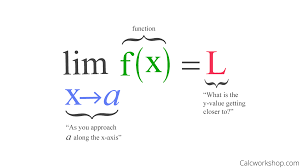
How Do Limits Work?
Limits are a formal, mathematical way of saying "At what value is this function approaching the input that I gave it?". As shown in the image above, there are 3 parts that make up a limit. The first part is your input, whatever this is dictates what your answer will be. The second part is the function itself, which gives you the ability to use a graphing calculator to see how the limit works. The final part is the answer, which shows what value of Y you get for your input. To solve a limit like this, you would plug in your input into the function to get Y.
There are different kinds of limits, which help address different problems. We already know the normal, two sided limit, but there also exists a one-sided limit. A one-sided limit addresses the issue of a line breaking up and moving up somewhere else on a graph, before continuing. One-sided limits are split up between left (negative limit) and right (positive limit) to show this break. Another kind of limit happens when the graph converges onto infinity. It is shown similarly to two-sided limits, but the input becomes infinity. For certain limits such as ones that go to infinity, your options for solving the limit are reduced to graphing it with a calculator.
This audio file describes an infinite limit where X shoots off to infinity at the Y value of 2.
This audio file describes two one-sided limits. Notice the "jump" in the y-values. This is because the line does not connect all the way, so there needs to be two limits to account for this. One of the lines starts from the left and stops at 2, and it picks up at -2 and keeps going right.